$5 Gas
I don’t know if you noticed, but gas prices are high.
The Zelaya household doesn’t drive much. We own a Cadillac Lyriq (electric) and a 2010 Prius. We haven’t put gas in the Prius for almost three months.
Humble brag.
So you can imagine my shock when it cost me over $50 to fill up the Prius last week. I haven’t paid more than $40 to fill that car in years.
My situation is nothing compared to many across America. A friend of mine in Texas drives an SUV. It easily costs him over $100 to fill the tank.
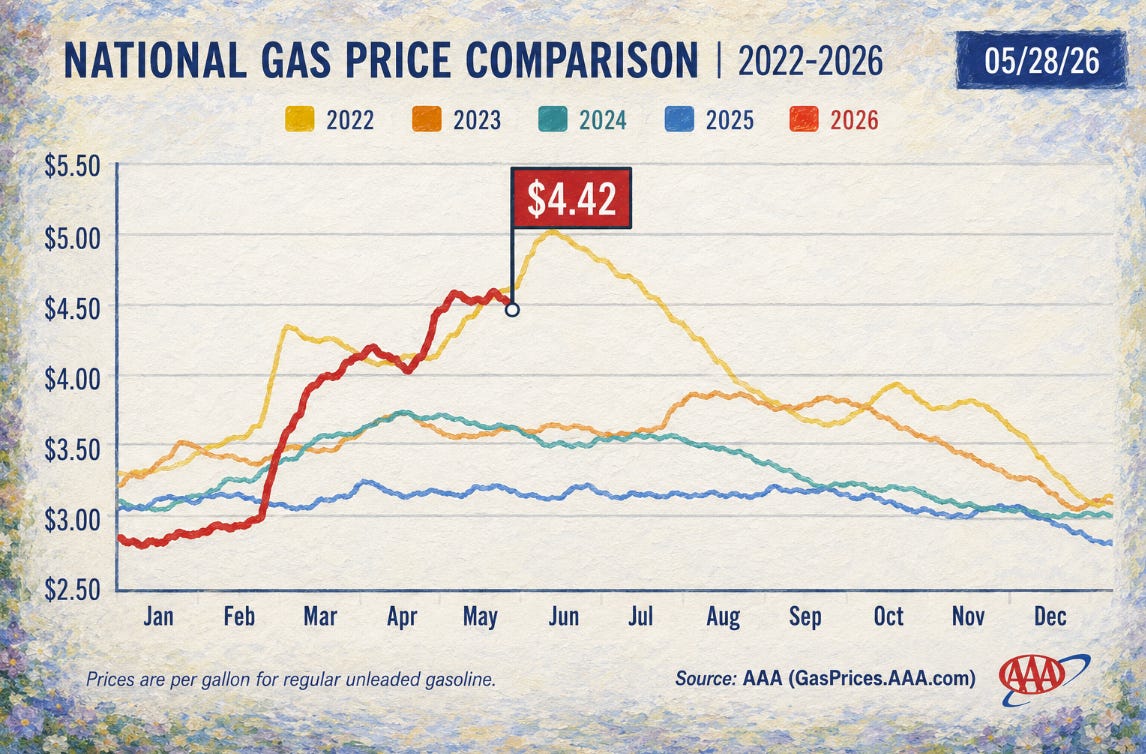
I’ll go on a limb here and say that more Americans know the price of a gallon of gas than the balance of their retirement account.
Gas prices are impossible to ignore. You see them driving to work, dropping kids at school, and running errands. They are the most visible price in the economy.
Which brings me to inflation.
Inflation is up 3.8% over the last year1. But that number means something different for every single household in America.
There is no such thing as average inflation.
Last year, I wrote about a story from Todd Rose’s book The End of Average.
He found that in the late 1940s and early 1950s, U.S. Air Force pilots were crashing at high rates. At one point, seventeen planes crashed in a single day.
Officials blamed pilot error.
But a researcher named Gilbert Daniels thought it could have been the cockpit itself (designed for the “average pilot”) that was the real problem.
He measured over 4,000 pilots across 140 physical dimensions (height, arm length, chest width, leg length, etc.). Then he checked how many of them were “average” across all measurements.
Not one pilot was average.
The cockpit had been designed for a mythical average pilot who didn’t exist.
The solution was adjustable seats, control sticks, and everything in between.
Crashes dropped almost instantly.
There is no average pilot, just like there is no average inflation.
Higher gas prices affect different income groups differently.
Lower-income households feel the higher gas prices the hardest.
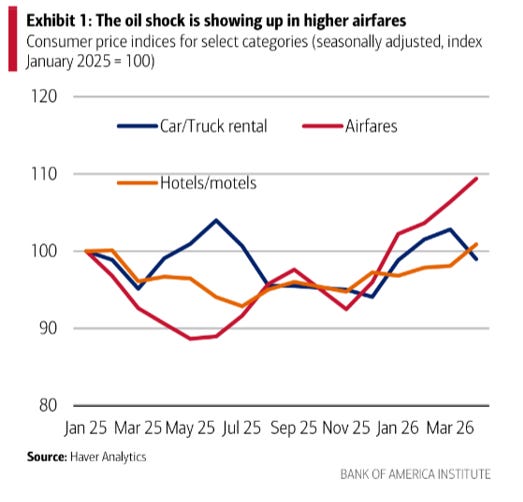
Higher-income households are less affected by gas prices, but they might be frustrated about the cost of airline tickets.
Bank of America shows that airfare prices have accelerated since the war began.
Professor Scott Galloway recently said this about inflation:
When people aren’t working, they get antsy and angry. That’s true. But where people get violent or chaotic is when they’re working, and they’re still hungry. That’s what inflation does.
Higher gas prices could become the deciding factor in November.
Polymarket currently gives Democrats an 81% chance of winning the House. The Senate is essentially a toss-up, with Republicans holding a slight 54% edge.
The longer these higher pump prices persist, the more likely consumers and businesses could start changing their transportation behavior, which could lead to a bigger change in D.C.
Keep learning. Keep growing. Keep going.
1: Source: Bureau of Labor Statistics. May 12, 2026. https://www.bls.gov/news.release/cpi.nr0.htm
Now here’s what I’ve been reading, listening, and watching:
Berkshire, Big Tech, and the Rise of the AI Economy | Compounding Wisdom | Ludacka Wealth Partners
Steve Ballmer Explains: The Federal Reserve | Just the Facts
Aswath Damodaran: The AI Boom Is Headed For A Reckoning | Prof G Markets
Jeff Kinney | Diary of a Wimpy Kid: Partypooper | Talks at Google
Marc Andreessen’s Worldview in 60 Minutes | Live on MTS | a16z
Goldman Sachs Chairman on Why Finance Adopts AI Differently | a16z
The Valuation Treadmill by James Park
Here Were My Top 5 Posts From May: