Everyone Knows Everything
In 1602, the Dutch East India Company became the first public company to issue shares.
Before that, only the wealthy had enough money to invest.
This was the first time that everyday people could buy a piece of a company and share in both the risk and the reward.
That experiment paved the way for four centuries of innovation, allowing ordinary people to invest their money.
But there were significant frictions along the way.
Getting reliable information was hard.
This is why Warren Buffett drove to the library to read financial statements that were not widely available.
When the library didn’t have what he needed, he called companies directly and asked their investor relations department to mail him the annual report.
There was an investment edge with information.
A few years ago, I was in an Uber in San Francisco. My driver, Dave, was chatty and inquisitive.
He asked what I did for work. After I told him I was in finance, he shared the story of when he bought Apple for the first time, almost 30 years ago.
He said he had to call his broker, who would call the floor trader to place his trade, all the while costing Dave $60 for the privilege of participating in American capitalism.
There was an investment edge in execution speed.
Those days are long gone. The barriers to entry have never been lower.
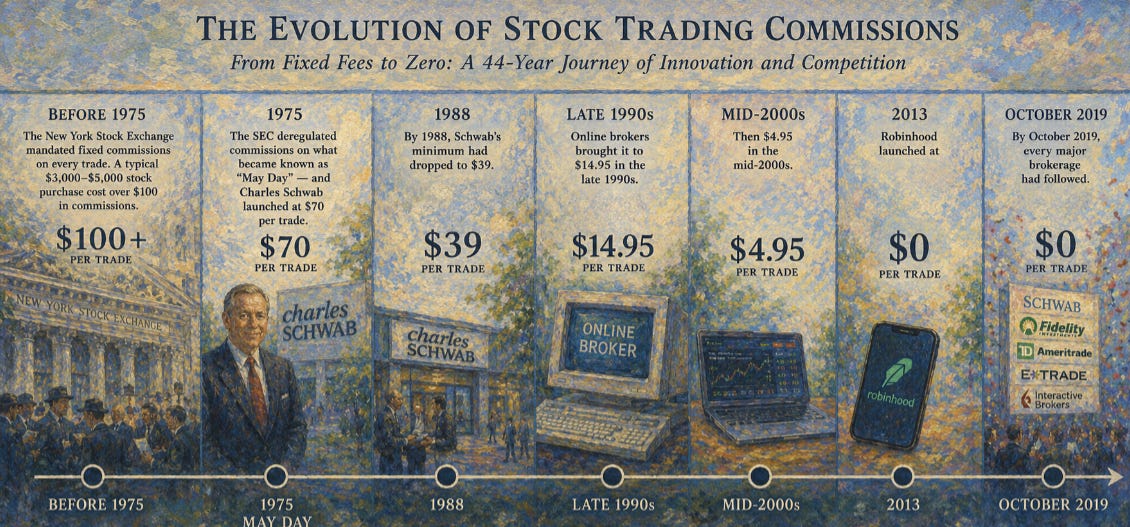
Before 1975, the New York Stock Exchange mandated fixed commissions on every trade. A typical $3,000 to $5,000 stock purchase cost over $100 in commissions.1
In 1975, the SEC deregulated commissions on what became known as “May Day,” and Charles Schwab launched at $70 per trade.2
Online brokers brought costs down even more in the late 1990s. In 2013, Robinhood launched at $0. By October 2019, every major brokerage had followed.
Today, you can open an app, search any company on earth, read its earnings call transcript, prompt an AI to summarize 300 pages of SEC filings, and place a trade, all before finishing your morning coffee.
The information and speed advantage is largely gone.
Everyone knows everything. Almost instantly.
So Where Is the Edge?
Charles Ellis, in his book Winning the Loser’s Game, writes that there are three ways to make money as an investor.
You can have better information than others.
Not much of an edge here because everyone is working from the same data now, and AI can get you every detail in seconds.
You can be faster than others.
Recently, Jane Street (a high-frequency trading firm) generated close to $40 billion in revenue by providing market liquidity. That’s more revenue than Starbucks. Good luck competing with those titans.
Or, you can be more patient than others.
Meb Faber (who Jared and I recently had the pleasure of chatting with) recommends holding investments for 10 to 20 years.
Many investors don’t want to wait that long.
Meb surveyed his audience on X and found that most would only wait 3 years or less before selling out of an underperforming money manager.
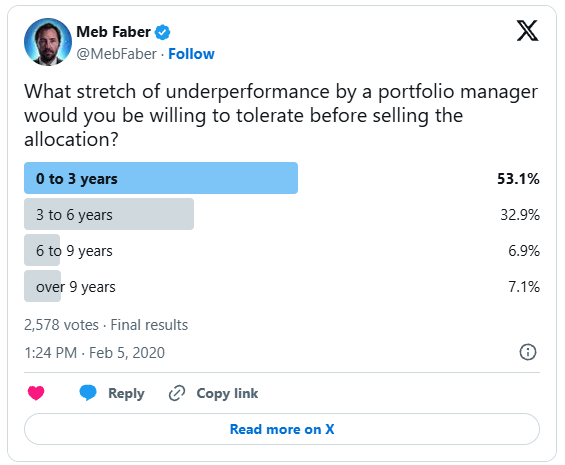
The gap between 3 years and 20 years is where most returns are lost.
My favorite president, Abraham Lincoln, understood the importance of patience when he said:
A man watches his pear tree day after day, impatient for the ripening of the fruit. Let him attempt to force the process, and he may spoil both fruit and tree. But let him patiently wait, and the ripe pear at length falls into his lap.
In a world of constant and immediate information, patience remains our greatest investing edge.
Keep learning. Keep growing. Keep going.
1: Source: New York Times. Market Place. Robert Metz. Feb. 25, 1970. https://www.nytimes.com/1970/02/25/archives/market-place-taking-a-look-at-commissions.html
2: Source: Nasdaq. Schwab Soared As Low Fees Spurred Investment Boom. April 21, 2014. https://www.nasdaq.com/articles/schwab-soared-low-fees-spurred-investment-boom-2014-04-21
Now here’s what I’ve been reading, listening, and watching:
Market Shrug Off Chaos as All-Time Highs Return | Compounding Wisdom | Ludacka Wealth Partners
Big Tech Dropping | Compounding Wisdom | Ludacka Wealth Partners
David Brooks: America Has a Moral Problem, Not a Political One | Prof G Conversations
Ben Horowitz on AI Anxiety, Big Tech Transitions & The Future of Startups | a16z
Marc Andreessen on how the internet changed news, politics, and outrage | The a16z Show
The Valuation Treadmill by James Park
May Contain Lies by Adam Edmans
Here’s what I’ve been writing: